

EDITOR'S NOTE 👋
Hey there 👋
Charles Schwab's CEO, Rick Wurster, told Bloomberg in October that the firm blocks unauthorized AI agents trying to move client money "10 to 20 times per week." JPMorgan Chase has said it won't let outside agents log in with customers' credentials, and Citi has said it doesn't let third-party AI agents log into customer accounts either.
Those are agents acting inside accounts people already have.
The next step is agents choosing the account in the first place, which means comparing savings rates, card fees, or business accounts and starting the application for the human, who then just approves it.
That isn't mainstream yet, but the pieces are arriving fast.
On November 13, OpenAI started rolling out ChatGPT Wallet in dots, its personal agents, which lets them pay for purchases once you approve them.
Since April, the fintech Meow has let eligible businesses use an AI agent to help apply for a business checking account. In the US, ChatGPT can read linked bank accounts through Plaid. And last week's issue covered Omniscient Digital's study showing AI often changes how it recommends brands once it knows a detail about the buyer.
This week covers where agents actually touch financial products today, and five things you can do now so that when an agent is shopping your category, your product is one it can understand, compare, and pick.
Let's go. 🚀
TL;DR 📝
JPMorgan Chase, Schwab, and Citi have all said they restrict outside AI agents from logging into customer accounts directly. Wells Fargo's revised terms, effective November 24, put responsibility for third-party agents on customers, subject to applicable law, while keeping the bank's right to restrict or block access.
ChatGPT Wallet, which OpenAI started rolling out in dots on November 13 with American Express, Chase, Mastercard, and Visa, lets its agents pay for purchases, starting with US ChatGPT Pro subscribers.
Agents choosing financial products for people is still early, but 23% of consumers McKinsey surveyed already use generative AI for financial tasks at least monthly.
Make rates, fees, and eligibility easy to find on public product pages, and don't make agents depend on PDFs, interactive calculators, or logged-in areas for the essentials.
Buyers will hand agents specific limits, and in a benchmark by researchers at Cisco and Carnegie Mellon, explicit price limits like "under $200" generally narrowed wealth-based differences in what agents recommended more than asking for "the cheapest" did. Put your exact fees and rates where an agent can check them.
Check that your bot protection isn't blocking verified AI agents from your public product pages, then send an agent shopping in your category and watch where it gets stuck.
WORK WITH ME 🤝

Alongside this newsletter, I help financial brands get found on Google, ChatGPT, Perplexity, and Google AI Mode, either directly or through my agency, Rise Up Media.
If you'd like help with yours, tell me what you're working on. It takes two minutes.
NEWS YOU CAN USE 📰

ChatGPT's agents can now pay. On November 13, OpenAI started rolling out ChatGPT Wallet in dots, its personal agents, built with American Express, Chase, Mastercard, and Visa. You add a card once, review each purchase, and approve it with a security check such as Face ID or a fingerprint. The payment network then issues a stand-in card number, so neither the agent nor the business sees your real card details, and you keep your card's rewards and its protections for eligible disputes. For now, it's limited to US ChatGPT Pro subscribers aged 18 and over with eligible US-issued cards. [Source: OpenAI]
The big banks are drawing lines on AI agents. Law firm Hunton Andrews Kurth published a roundup on November 3 of how US banks are responding to customer-directed AI agents. JPMorgan Chase said on October 13 that it won't allow third parties to log in with customers' credentials, after Jamie Dimon named agents including Muse and Instinct on the earnings call. Chase still allows authorized, read-only data sharing, like balances, through open banking providers such as Plaid, which is a separate channel. Schwab's CEO said the firm blocks unauthorized agents trying to move client money, and Citi said on October 16 that it doesn't permit third-party AI agents to log into customer accounts. Wells Fargo's revised terms, effective November 24, address third-party AI agents by putting responsibility on customers, subject to applicable law, while reserving the bank's right to restrict or block access. [Source: Hunton Andrews Kurth]
HOW TO MAKE YOUR FINANCIAL PRODUCT EASY FOR AN AI AGENT TO CHOOSE 🧠
Most of the work here overlaps with good AI search optimization. An agent researching business accounts may consult many of the same public sources an AI search tool uses when a person asks the question. The difference is that the agent may also act on what it finds.
There are five steps. The first is about knowing what's real today. The other four are things you can do this quarter.
1. Know Where Agents Touch Your Category Today
It's easy to overstate this.
Agents already work inside bank accounts. That's what the banks above are blocking, and the White House's AI adviser, David Sacks, described those user-authorized agents as "in no way cyberattacks," according to CBS News.
Agents can open accounts (in a few places). Since April 9, Meow has let eligible businesses use an assistant like Claude or ChatGPT to help apply for a business checking account, then issue cards and create invoices. The applicant still completes identity verification, agents can't move money on their own by default, and payments can require a human's approval.
Now, your AI agents can also pay. ChatGPT Wallet lets OpenAI's agents complete purchases with a stand-in card number after the user approves each one. It covers shopping, not financial products, which come with their own applications, identity checks, and rules.
And AI is already shaping the decision even when a human clicks the button. McKinsey found in its 2025 survey that 23% of respondents use generative AI for financial tasks at least monthly, with comparing products among the top uses. That's people using AI to research, not agents acting alone, and Adobe reported that traffic from generative AI sources to US banking sites rose 1,200% between July 2024 and February 2025, from a small base.
What's missing is consumer trust in letting AI finish the job. In Visa research with Morning Consult published in April, 38% of US adults were comfortable with AI completing a purchase, and 60% wouldn't let it spend any amount without their approval. That's about purchases in general, not specifically financial products.
So the near-term version is an agent that does the research, builds the shortlist, and hands a human one button to press.
2. Put the Facts an Agent Compares on a Public Page
An agent comparing savings accounts needs the rate, the minimum balance, the fees, who's eligible, and who regulates you. If any of those lives only in a PDF, an interactive calculator, a "contact us for pricing" form, or behind a login, the agent may struggle to find it. Some agents read PDFs fine, and some don't, so don't make the essentials depend on it. When it can't find your number, it can still compare your competitor's.
Go through your top three products and check each decision fact.
Is it on a crawlable page?
Is it written as text, in a sentence an agent can quote?
Is it current?
Write eligibility in plain terms too. "Available to UK-registered limited companies with annual turnover under £5 million" gives an agent something to match against. "Designed for growing businesses" doesn't.
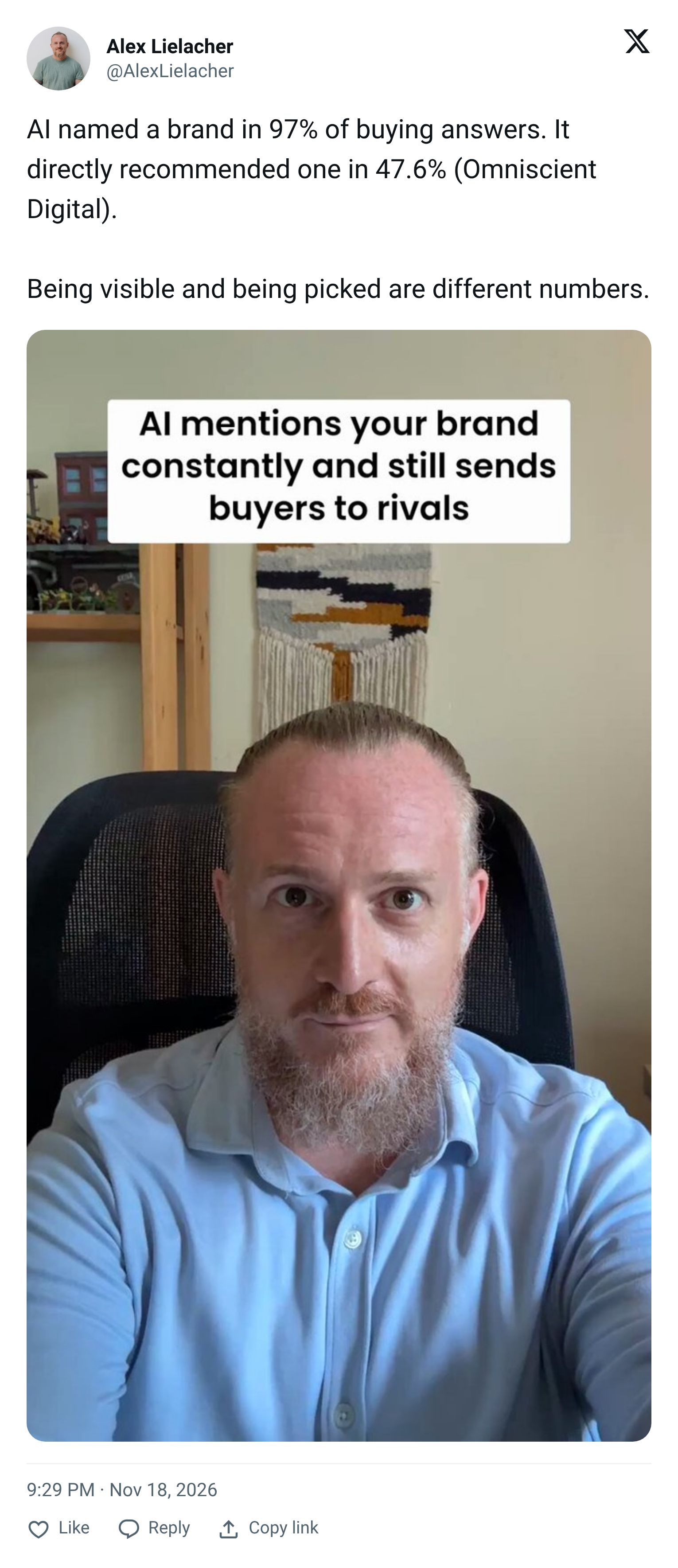
Last week's Omniscient data showed why this matters. Among brands that appeared in both versions of a matched prompt, adding one buyer detail changed how 38% to 65% of them were recommended. Agents work from the details their human gives them, so every condition you publish is a chance to match.
You can also add financial product markup from schema.org, such as FinancialProduct, BankAccount, LoanOrCredit, and properties like annualPercentageRate and feesAndCommissionsSpecification. I haven't seen evidence that today's agents rely on it, so treat it as tidy labeling on top of clear page copy, not a replacement for it.
3. Publish Exact Numbers
People will give agents constraints: "a business account with no monthly fee," "a card with no FX fee," "a savings account paying at least 4%." Your page should answer those in numbers.
A preprint from researchers at Cisco and Carnegie Mellon, which hasn't been peer-reviewed yet, tested 13 models across 325,000 benchmark runs on tasks like finding the cheapest flight or a health insurance plan. In that benchmark, giving the agent an explicit price limit, like "under $200," generally narrowed the gap between what it recommended to wealthy and low-income users more than asking for "the cheapest" did.
The same paper found something more uncomfortable. 8 of the 13 models recommended pricier options when they believed the user was wealthy. In one simulated test, an agent picked a $601 business-class flight over a $91 one still available, after reading emails that suggested the user had money.
The study tested what users tell agents, not what brands publish, so it doesn't prove clear pricing gets you picked more often. But if buyers are going to hand agents specific limits, I'd want my exact fees and rates on the page where an agent can check them against those limits.
4. Make Sure Agents Can Reach Your Public Pages
Your bot protection might be blocking the agents you want. Firewalls and bot tools are built to stop automated traffic, and an AI agent browsing for a customer looks automated.
Public product pages, fee pages, help articles, and rate tables should be readable by AI assistants and agents. If an agent can't reach your fee or eligibility page, it may leave your product out or compare it using other sources. Logged-in banking is a security and legal decision, and it belongs with your security and legal teams, as the banks above show.
Don't rely on user-agent names alone, because anyone can fake one. Look for verified identity instead. OpenAI's allowlisting guidance for ChatGPT Work's cloud browser uses signed requests, which let a site check that traffic really comes from OpenAI, and it lists several bot-management providers that support them. Its new playbook for ChatGPT Wallet asks businesses to do exactly this, and to check that general security rules don't block ChatGPT agents.
The payment networks are working on the same problem. Mastercard announced a probability score for identifying AI-initiated transactions in September, rolling out for US testing, alongside work with Cloudflare and Skyfire on agent trust and recognition.
5. Send an Agent Shopping and Watch Where It Fails
The fastest way to see your product the way an agent does is to hand one the job.
Use ChatGPT's browsing agent, or any assistant that can browse websites for you, and give it a realistic task in your category with real constraints. Watch it work. Note where it hits a CAPTCHA, can't find a fee, misreads eligibility, or gives up and picks a competitor because their page was clearer.
Every one of those failures is a fix with a clear owner. A missing fee goes to the product page team. A blocked page goes to whoever manages your firewall. A confusing eligibility rule goes to compliance and content together.
Run the same task on two or three competitors' products too. If the agent keeps picking them, check whether clearer product information on their pages explains the difference.
THIS WEEK'S PROMPT 🧠

This prompt turns step 5 into a repeatable test. It's built for an assistant that can browse websites, like ChatGPT's browsing agent.
The Scenario: You market a business account, card, or savings product. You want to see how an AI agent compares your product with competitors when a customer hands it a real task, and where your site makes that harder than it should be.
The Prompt:
You're shopping on my behalf, but this is a test. Don't create accounts, fill in forms, enter personal information, or start any application.
My task: find the best [PRODUCT TYPE, e.g. business current account] for [CUSTOMER PROFILE, e.g. a UK limited company with two directors that invoices clients in euros].
My requirements: [CONSTRAINTS, e.g. no monthly fee, FX fee under 0.5%, eligible deposits covered by the FSCS, a published opening time of under a week].
Compare these providers using only their own public websites: [YOUR BRAND], [COMPETITOR 1], [COMPETITOR 2], [COMPETITOR 3].
For each provider:
Find each requirement on their site and link to the exact page. Quote the wording.
If you can't find a requirement, say so. Don't guess or use outside sources.
For deposit protection, name the institution that actually holds the money, and say whether the provider is a bank or a payment firm that safeguards funds instead.
For timings, quote the provider's published timeframe. Don't treat it as a guarantee.
Note anything that slowed you down: logins, CAPTCHAs, PDFs, calculators you couldn't read, unclear eligibility rules, or pages that wouldn't load.
Then tell me which provider you'd pick and why, based only on what you found. If none meets every requirement, say which comes closest and what's missing.
Output a table with these columns: Provider | Requirement | Meets requirement / Does not meet / Could not verify | Exact wording | Link | What got in the way.
Run it with three different customer profiles to see how the shortlist changes with the buyer. Then run the same profile again in a fresh session to see whether the agent finds the same fees and terms each time.
If a competitor keeps winning, use the quoted evidence to tell whether they have a better offer or just a page the agent found easier to read. If you lose because the agent couldn't verify a fact you actually offer, that's the first page to fix.
For a real purchase decision in the UK, check deposit protection directly with the FSCS. The FCA treats safeguarding at payment firms differently from bank deposit protection.
WRAPPING UP 🌯
Know what's real today, put your decision facts on public pages, publish exact numbers, let agents reach your product pages, and send one shopping to see what breaks.
Agents choosing financial products for people is early, but people already use AI to compare accounts, so check whether it can find the rates, fees, and eligibility rules a customer needs to put yours on the shortlist.
Fix the page the agent couldn't read before you worry about the agent that can't log in.
Until next time, keep exploring the horizon. 🌅
Alex Lielacher
P.S. If you want your brand to show up in Google AI Mode, ChatGPT, and Perplexity, reach out to me.
