
EDITOR'S NOTE 👋
Hey there 👋
Last week was about measuring the sales that start in ChatGPT. This week is about what ChatGPT tells the buyer before that sale happens, and where it gets its material.
Mostly, not from you.
In Muck Rack's latest analysis of more than 200 million AI citations, more than 84% came from sources brands don't own or pay for, such as journalism, Wikipedia, government sites, academic research, and other companies' content.
Brands' own pages made up 15.2%. That's a count of cited links across general questions, not a measure of how much each source shapes an answer about your brand specifically, but it's the largest dataset on this I've seen.
For financial brands, that gap matters more. OpenAI's Adam Fry said on November 2 that finance questions are among the ones where ChatGPT runs a web search. So when someone asks whether your app is safe or what your fees are, the answer may draw on whatever ChatGPT finds about you online, including outdated claims.
This issue covers the six kinds of sources AI uses to describe a brand, what each one is good for, and how to audit all six in an afternoon.
Let's go. 🚀
TL;DR 📝
More than 84% of citations in Muck Rack's latest analysis came from earned and third-party sources, and that share has stayed between 82% and 89% across all four editions of its report.
Journalism's share of those citations fell from 27% in May to 22% in September, while government sites, encyclopedias, academic research, and other companies' content picked up most of the slack.
Reddit, YouTube, LinkedIn, and Wikipedia were the four most-cited domains in Peec AI's March analysis of 30 million US sources, with G2 and Yelp also in the top 10. However, Reddit and Wikipedia reportedly dropped off recently.
Branded web mentions had the strongest correlation with AI Overview visibility of the factors Ahrefs tested across 75,000 brands (0.664), which is a good reason to treat coverage as more than vanity.
Your own site still answers the factual questions, like fees and features, but it can't vouch for you on its own.
Start by logging what AI cites when you ask it real buyer questions about you and your competitors, then fix the sources that are wrong before you try to add new ones.
WORK WITH ME 🤝

Alongside this newsletter, I help financial, fintech, and crypto brands get found on Google, ChatGPT, Perplexity, and Google AI Mode, either directly or through my agency, Rise Up Media.
If you'd like help with yours, tell me what you're working on. It takes two minutes.
NEWS YOU CAN USE 📰

Earned media still drives most AI citations, but journalism's slice is shrinking. Muck Rack's fourth "What Is AI Reading?" report, published October 28, covers more than 40 million AI responses and 207 million citations from January to September, plus a fresh set of 1,020 unbranded prompts run through ChatGPT, Claude, Gemini, and Perplexity in September. More than 84% of citations came from earned and third-party sources. Journalism dropped from 27% to 22%, the biggest shift Muck Rack has recorded, while owned media rose from 13.7% to 15.2%. Two other findings stood out. 81% of major publishers that block Claude's search crawler got almost no Claude citations, compared with 12% of those that allow it. And the same prompt run twice on the same day repeated only 41% of its cited domains in ChatGPT, against 94% in Perplexity. Note that Muck Rack's "earned" bucket is much wider than press coverage, so don't read 84% as "84% is PR." [Source: Muck Rack]
OpenAI says ChatGPT now handles about a fifth of Google's search volume. At an OpenAI dinner in New York on November 2, ChatGPT consumer product lead Adam Fry told Big Technology's Alex Kantrowitz that "ChatGPT's volume of search-like queries is now roughly one-fifth the volume of queries of Google." He defined those as anything a user would have taken to a search engine before, and named finance and health questions as ones where ChatGPT runs a web search. He also said ChatGPT went from 1 billion to 1.2 billion weekly active users in two months. The public part of the interview doesn't say how OpenAI counts a query, and a 20-prompt conversation could be one search or 20, so treat the ratio as OpenAI's own framing. [Source: Big Technology]
HOW TO AUDIT THE SIX SOURCES AI USES TO DESCRIBE YOUR BRAND 🧠
ChatGPT doesn't search the web for every question, but when it or AI Mode does search to answer something about your brand, it may run several related searches, read what comes back, add what the model learned in training, and write one answer.
It works a lot like a reference check: your website gets a say, and so do your customers, your critics, the press, and every directory that lists you.
Six source types are worth checking. I'd go through them in this order, because the first two are the fastest to fix and the last four take longer to move.
1. Your Own Website
Your site is the obvious place for facts: what you charge, which countries you serve, who regulates you, how long a transfer takes. Muck Rack says owned content matters most for product questions and how-to queries, where product pages and guides get cited.
So make those facts easy to lift. Put your fees, limits, licenses, and supported markets in plain sentences on pages that load without a login, and keep them current. If a review says you charge no FX markup and your pricing page doesn't say either way, you've left the model to guess.
What your site can't do is vouch for itself. Calling yourself "the most trusted financial advisor in Michigan" on your homepage doesn't make an AI answer say it. Muck Rack's own conclusion is that brands can't build meaningful AI visibility from their website alone.
2. Directories and Knowledge Bases
Wikipedia, Wikidata, LinkedIn, Crunchbase, Google Business Profile, G2 category pages, and industry directories all do the same job. They tell AI what you are, which category you belong in, and who you compete with.
For financial brands, I'd add one more: your regulator's public register. Buyers ask "Is [brand] regulated?" all the time, and the FCA register, FINRA's BrokerCheck, or the NMLS listing is where the honest answer lives. Make sure the name and details there match everything else.
I'd call this the cheapest layer to fix, and the most neglected. If three listings put you in three different categories, or one still shows a product you shut down in 2024, AI has conflicting facts to choose from. Audit every listing you can find and make your name, description, category, founding year, and leadership the same everywhere.
3. Reddit and Forums
Forums are where buyers ask the questions you'd rather answer yourself: "Is it safe?", "What are the downsides?", "What do people use instead?" In finance, that means r/personalfinance, r/UKPersonalFinance and r/CryptoCurrency, plus communities like the Bogleheads and MoneySavingExpert forums.
But don't build your plan around Reddit. ChatGPT's citations from Reddit fell off a cliff in mid-August. PromptWatch data reported by Forbes showed Reddit's share of ChatGPT citations drop from 3.8% to 0.52% within about a week, an 86% fall. Dageno, tracking a fixed set of questions, found the share of ChatGPT answers with a Reddit link went from 34.8% in February to 1.4% in September. OpenAI hasn't explained the change, and none of the trackers I checked show a lasting recovery through October.
Google is a different story, at least for now. In Dageno's September data, 38.6% of AI Overviews answers and 27.7% of AI Mode answers with source links included Reddit. Cheers, which tracks home-service questions, saw AI Mode's Reddit share fall too, so the exact number depends on what you ask. Forum threads still feed Google's AI answers, and on ChatGPT they can disappear in a week.
So treat forums as one source out of six. Answer questions under a clearly disclosed company account, run anything you post past compliance, and fix the problems people keep complaining about. Communities spot astroturfing fast, and a thread calling you out for it is one more page AI can read.
4. Review Platforms
Reviews give AI a verdict to repeat. G2 and Yelp both made Peec's overall top 10, with Trustpilot and Clutch further down the top 100.
Pick the two platforms that matter most in your category. For a B2B fintech, that's probably G2. For a consumer app, it's often Trustpilot and the app stores. Keep the profiles complete, ask real customers for reviews, and reply to the complaints as well as the praise, because a public reply with the current facts sits right next to the complaint it answers.
5. Publications
Journalism made up 22% of citations in Muck Rack's September data, down from 27% in May. That's still more than a fifth of everything AI cites, and it's where claims like "one of the fastest-growing neobanks in Europe" pick up weight.
Aim your PR at the outlets AI already cites for your category, even when they're smaller than the ones you'd normally chase. Check which publications show up when you ask AI about your competitors, then pitch those. Original data and expert commentary give journalists a reason to come back to you. A funding announcement mostly doesn't.
Coverage works partly because it spreads your name around, and that seems to count. In Ahrefs' 2025 study of 75,000 brands, branded web mentions had the strongest correlation with AI Overview visibility of the factors it tested (0.664), ahead of backlinks and domain rating.
Crawler restrictions are worth checking too. Muck Rack found that 81% of major publishers blocking Claude's search crawler got almost no Claude citations, compared with 12% of those that allow it. That's one engine and an association rather than proof, but before you chase a placement, check whether the outlet blocks the crawlers of the engines your buyers use.
YouTube was the second most-cited domain in Peec's March study, ahead of Wikipedia, and it led the list for AI Mode and AI Overviews.
Video gives AI evidence of how your product works in someone else's hands: walkthroughs, comparisons, and reviews from independent creators. For financial brands, "how to open an account with [brand]" and "[brand] vs [competitor]" videos are the obvious first targets.
Get into other people's content as much as making your own. Give credible creators access to your product, go on industry podcasts that publish to YouTube, and make sure your own videos have accurate titles, descriptions, and transcripts.
How the Six Fit Together
No single source decides the answer. My view is that AI repeats whatever most of these sources agree on, and when they disagree, you're more likely to get a hedge, or no mention at all.
Source | What AI takes from it | Questions it answers | Your main lever |
|---|---|---|---|
Your website | Fees, features, markets, licenses | What does it cost? How does it work? | Clear, current, crawlable facts |
Directories and registers | Identity, category, regulation | What is this company? Is it regulated? | The same facts everywhere |
Forums | Unfiltered opinions, trade-offs | Is it worth it? What else do people use? | Honest, disclosed participation |
Review platforms | Sentiment and verdicts | Is it any good? | Complete profiles, public replies |
Publications | Third-party credibility | Who's leading this space? | Coverage in outlets AI cites |
Video and social | Hands-on evidence | What's it like to use? | Creator and podcast placements |
One caveat on all of this. Most of the numbers above come from vendors that sell AI visibility tools, and the Ahrefs figure is a correlation from AI Overviews only. The pattern is consistent across them, which is why I trust the direction, but none of it tells you exactly how much each source moves your own answers. Your own audit will do that for you.
BRACE YOURSELF, VIDEO CONTENT IS COMING
I recently reconnected with an old friend who runs a weekly segment on Der Aktionär TV (The Shareholder TV) on YouTube, and he asked me if I wanted to be on it. Since I have been meaning to do video content for a while, I took this as the sign to finally get started.
The clip aired last Monday, and it was very weird to see my face on a video that got 35,000+ views, BUT it got me started with standing in front of the camera.
After recording for Der Aktionär, I did some more content with my son, which was a lot less serious.
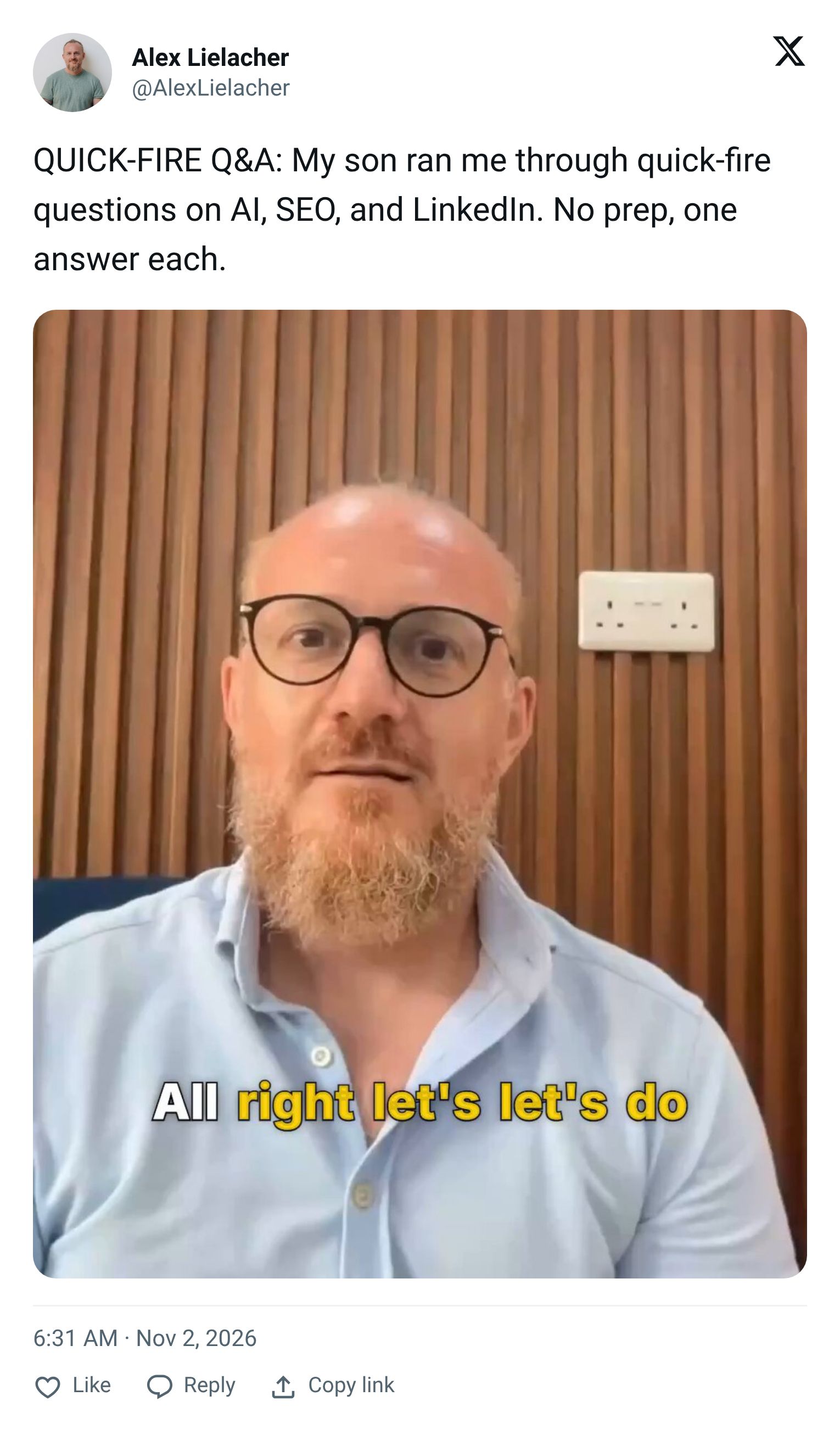
The plan is to start producing more video content, so feel free to keep me accountable.
THIS WEEK'S PROMPT 🧠

This comes in two parts. The first shows you what AI cites when buyers ask about you. The second audits all six source types. Keep them separate, because naming the source types in a prompt steers what the model goes looking for.
The Scenario: You're head of marketing at a fintech. Your site is accurate, but when you ask AI about your company, the answers feel off: an old fee, the wrong category, or a competitor recommended in your place. You want to know which sources are shaping that picture and where the gaps are.
Part 1: What buyers see. Run five or six questions your buyers actually ask, one per chat, without mentioning any source types. For example:
Is [BRAND] safe to use?
What are [BRAND]'s fees?
[BRAND] vs [COMPETITOR]: which is better for [USE CASE]?
Log every source each answer cites. That list is what's shaping normal answers today.
Part 2: The six-source audit.
You're helping me audit what third-party sources on the web say about my brand, so I can see what AI search engines have to work with.
Brand: [BRAND NAME] Website: [URL] Category: [CATEGORY] Main competitors: [COMPETITOR 1], [COMPETITOR 2], [COMPETITOR 3] How we describe ourselves: [ONE-SENTENCE POSITIONING] Key facts: [FEES, MARKETS, REGULATOR AND LICENSE NUMBER, FOUNDING YEAR, CEO]
Search the web and do the following. Cite a link for every claim.
Describe my brand in three sentences, using only third-party sources, the way you'd explain it to a buyer. Then list where that description differs from how we describe ourselves.
For each of these six source types, list what you found and quote what it says about us: our own website; directories and knowledge bases (Wikipedia, Wikidata, LinkedIn, Crunchbase, G2, and our regulator's public register); Reddit and forums; review platforms; news and trade publications; YouTube and social video.
For each source type where you found little or nothing about us, name the competitor with the strongest presence there and link to where it appears.
Quote any claims that contradict each other or our key facts on category, fees, markets, regulation, or reputation.
List any facts that look out of date, with the source and the date of the page if it's shown.
Recommend five actions to make the third-party picture more accurate, ranked by impact against effort. Label these as recommendations based on what you found, not predictions of how any AI engine will respond.
Rules:
Only include sources you found and opened in this session.
If you can't find anything for a source type, say so. Don't fill the gap.
Don't tell me how AI engines weight sources. Stick to what the sources say.
Run both parts in ChatGPT and Perplexity, then run Part 1 again in ChatGPT the next day. Compare the Part 1 citations with what Part 2 finds: anything that shows up in both deserves your attention first. Muck Rack found ChatGPT repeats fewer than half of its cited domains from one run to the next on the same day, so one pass won't show you everything.
WRAPPING UP 🌯
Get your own facts straight, make the directories and your regulator listing match, show up honestly in forums and on the review sites, earn coverage in the outlets AI already cites, and get your product into other people's videos.
Your website is still the best place to say what you do. It just isn't where most of the citations come from.
Start with the sources AI cites when buyers ask about your competitors. They'll tell you more about where to spend the next quarter than any list of platforms, including this one.
Until next time, keep exploring the horizon. 🌅
Alex Lielacher
P.S. If you want your brand to show up in Google AI Mode, ChatGPT, and Perplexity, reach out to my agency, Rise Up Media. That's what we do!

